
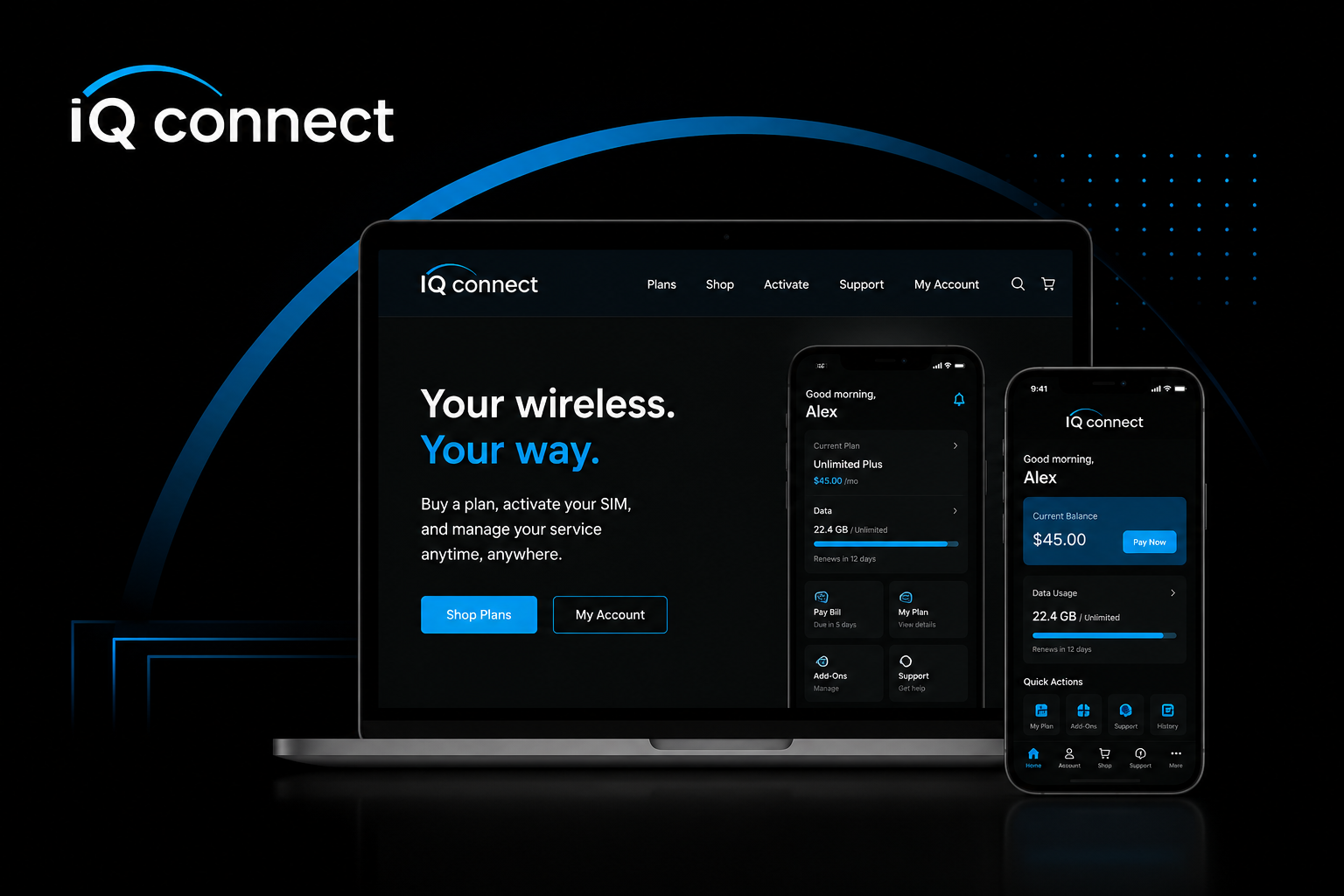
Branded Wireless Retail Website and Mobile App for MVNO Growth
Give wireless subscribers a branded way to buy plans, activate SIMs, pay bills, and manage service across web and mobile.
Why Wireless Operators Need a Connected Retail Website and Mobile App
Wireless customers do not want to manage service around store hours. They expect to buy a plan, activate a SIM, check their balance, pay a bill, and manage account details from any device.
For MVNOs, prepaid wireless brands, and telecom retailers, that expectation creates a clear operational requirement: digital channels cannot be treated as optional add-ons. A wireless brand that relies solely on in-store transactions, phone support, or a generic customer portal leaves revenue and retention exposed.
A branded retail website and native mobile app solve different parts of the same problem. The website helps capture demand, support plan discovery, and convert new subscribers. The mobile app helps retain customers, reduce reliance on support, and keep account management close to the user.
The strongest model is not “website plus app.” It is one connected digital ecosystem.
The Problem With Disconnected Wireless Customer Journeys
Many wireless brands still make customers work too hard to complete basic actions.
A prospective customer may want to compare plans on a Sunday night. A subscriber may need to make a payment after store hours. Another may want to check the balance, change a plan, or activate a SIM without calling support.
If those actions require a store visit, a manual process, or a third-party portal that weakens the brand experience, the operator loses control of the relationship.
That friction creates measurable business risk:
Customers abandon planned purchases before activation.
Subscribers contact support for routine account tasks.
Payment delays increase avoidable service interruptions.
Generic portals reduce brand trust and ownership.
Retail teams stay overloaded with transactions that should be self-service.
For wireless operators, every missed digital touchpoint is not automatically churn, but it does increase friction. In a competitive prepaid and MVNO market, friction is enough to push customers toward easier alternatives.
A Wireless Retail Website Turns Search Demand Into Subscriber Growth
A branded retail website should operate as a 24/7 sales and service channel. It should not be limited to static plan information.
For MVNOs and wireless operators, the website is the acquisition layer. It gives the brand a crawlable, indexable destination that can rank for commercial and transactional searches such as prepaid wireless plans, SIM activation online, BYOD plans, MVNO plans, wireless refill, and mobile plan checkout.
Branded Plan Discovery
Customers should be able to browse plans, compare options, review pricing, and understand activation requirements before speaking to anyone.
This supports higher-intent conversion because users arrive with clearer expectations. It also reduces pressure on retail associates and support teams.
Online SIM Activation
SIM activation is one of the most important conversion points in wireless e-commerce. If the customer has already selected a plan, the activation flow should be simple, guided, and connected to the operator’s backend systems.
A strong online activation experience can reduce abandonment between purchase and service start.
Subscriber Account Management
The retail website should also support logged-in account actions. Subscribers need access to balance checks, payments, plan changes, account updates, and service information without relying on phone support.
This matters for both customer experience and cost-to-serve. Routine account management should not consume support capacity.
E-commerce and Secure Payments
Wireless e-commerce requires more than a generic shopping cart. Operators need secure checkout, multiple payment options, plan-specific purchase flows, and account-linked transactions.
Because online payments involve cardholder data, payment workflows should align with recognized payment security requirements, including PCI DSS standards where applicable.
PCI Security Standards Council — PCI DSS
A Native Mobile App Strengthens Retention After Activation
A website is essential for acquisition. A mobile app is essential for ongoing subscriber engagement.
Once a customer has joined the network, the mobile app becomes the most convenient branded service layer. It lives on the same device the subscriber uses for connectivity, payments, communication, and account access.
Self-Service on the Customer’s Device
A subscriber app should make essential service actions available without requiring a call or store visit.
Core app functionality should include:
Balance checks
Bill payment
Plan review
Plan updates
Account management
Service notifications
Promotion visibility
Support access
The value is not just convenience. It is operational deflection. Every task completed in-app is one less routine support interaction.
Push Notifications for Timely Subscriber Communication
Push notifications are one of the strongest reasons to invest in a native mobile app.
Operators can use push notifications for payment reminders, renewal alerts, service updates, promotional offers, referral campaigns, and low-balance notices.
The key is relevance. Notifications should be driven by accurate subscriber data, not broad blasts. Poor notification strategy creates fatigue. Data-driven messaging creates retention opportunities.
App Store Presence and Brand Trust
A polished mobile app can also strengthen brand legitimacy. For smaller MVNOs and regional wireless brands, App Store and Google Play presence signals that the operator has a serious customer experience infrastructure.
The app does not replace the website. It extends the relationship after acquisition.
Why Web and Mobile Work Better Together
A website and mobile app should not run on disconnected systems.
When digital channels operate separately, operators create duplicate management, inconsistent account data, delayed updates, reporting gaps, and support confusion. That defeats the purpose of digital transformation.
A connected platform creates one operational truth.
When a subscriber pays through the app, the account should update across the website. When a customer activates a SIM online, that status should be reflected in the broader subscriber record. When the operator launches a promotion, it should be manageable across channels without developer dependency.
A unified web and mobile ecosystem should support:
Real-time subscriber data
Synchronized billing and payment status
Plan management across channels
Branded customer experience
Centralized promotions
Consistent account visibility
Unified analytics
Reduced duplicate administration
This is where iQ Connect’s positioning is clear. Its retail website and native mobile app are built for wireless operators and integrated with the broader operation, including subscriber data, billing logic, e-commerce, activation, and real-time sync.
iQ Connect Retail Website and Mobile App
Who Benefits Most From a Branded Wireless Website and App?
This solution is most relevant for wireless brands that need digital ownership without creating disconnected tools.
MVNOs Launching a Digital Sales Channel
New or growing MVNOs need a way to sell plans, activate subscribers, and support customers without building every system from scratch.
A connected retail website and app can help accelerate launch while keeping the customer experience under the operator’s brand.
Wireless Retailers Expanding Beyond Foot Traffic
Retail-first wireless brands often have strong local sales operations but limited digital reach.
A branded website helps capture online demand. A mobile app helps retain customers after the store visit.
Prepaid Operators Focused on Renewals and Payments
Prepaid wireless depends heavily on renewal behavior. If paying or refilling is inconvenient, revenue becomes vulnerable.
Self-service payments, account visibility, and timely reminders can support better renewal consistency.
Operators Trying to Reduce Support Load
If support teams spend too much time on balance checks, payment questions, plan updates, and activation issues, digital self-service can reduce operational waste.
The goal is not to eliminate support. The goal is to reserve support for issues that actually require human assistance.
Wireless Customer Expectations Are Moving Faster Than Legacy Operations
Mobile usage, digital payments, and app-based customer service have changed subscribers' expectations of wireless providers.
Industry data continues to show the scale and importance of mobile connectivity. CTIA’s 2025 wireless survey highlights continued growth in wireless usage, messaging, voice minutes, and infrastructure investment in the United States. GSMA’s Mobile Economy 2026 report also frames mobile connectivity as a global digital services layer, with operators increasingly focused on monetization, AI, security, and service differentiation.
CTIA — 2025 Annual Survey Highlights
GSMA — The Mobile Economy 2026
Final Takeaway
Wireless operators do not need more disconnected digital tools. They need a branded customer experience that connects acquisition, activation, payments, account management, promotions, and retention.
A retail website helps customers discover, compare, buy, and activate. A native mobile app helps subscribers manage service, receive timely updates, and stay engaged after activation.
The strongest business case comes when both channels run on the same platform.
For MVNOs, prepaid wireless brands, and telecom retailers, a connected retail website and mobile app can reduce friction, improve self-service adoption, strengthen brand ownership, and support scalable digital growth.
Tags