
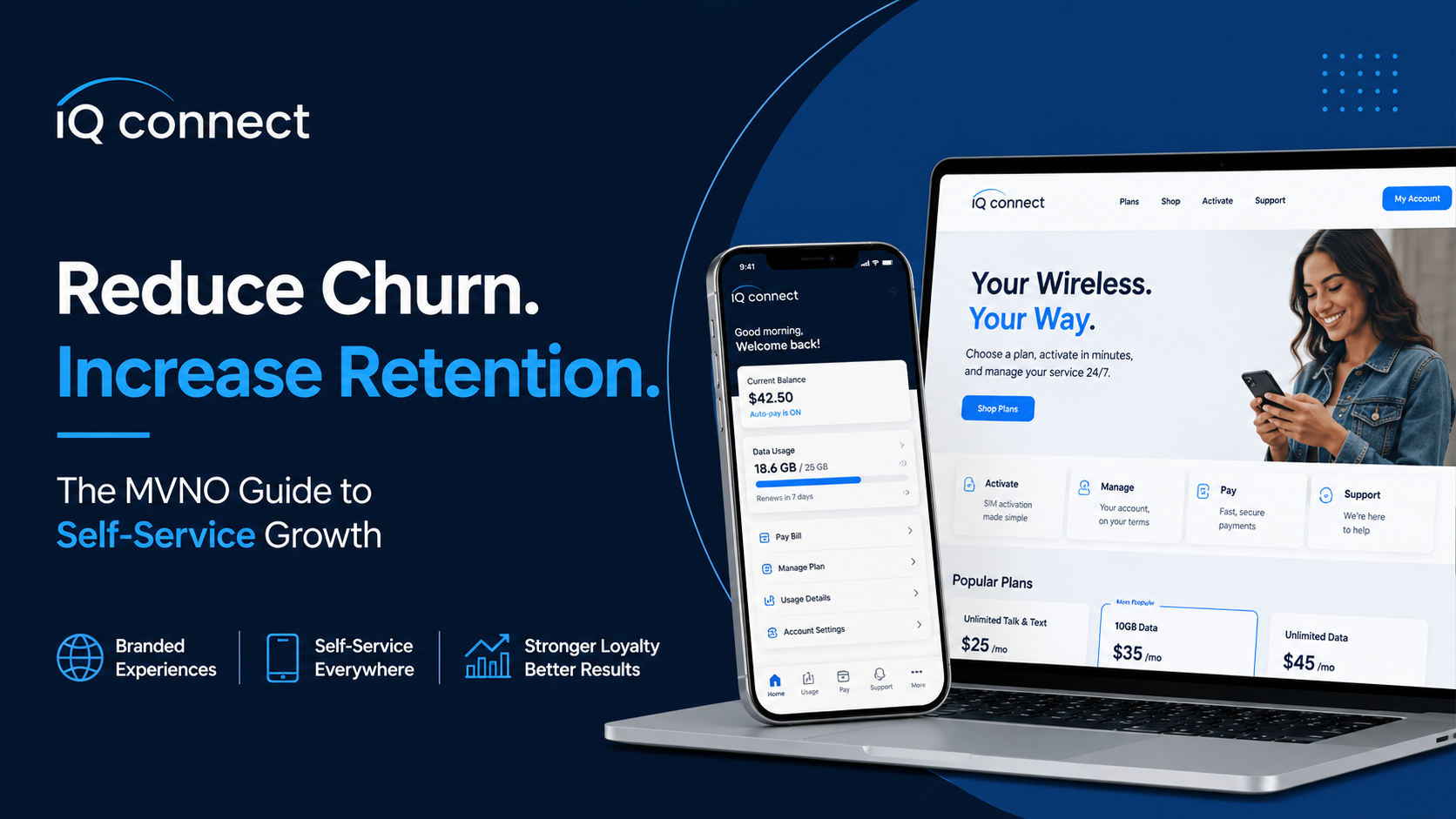
How MVNO Operators Reduce Churn With a Branded Self-Service Website and Mobile App
Learn how MVNO operators reduce churn, increase activations, and improve subscriber retention with a branded website and mobile app.
How MVNO Operators Reduce Churn With a Branded Self-Service Website and Mobile App
Wireless subscribers do not only compare plans by price. They compare how much effort each provider demands from them.
If a customer has to call support to check a balance, wait until Monday to change a plan, or visit a store to complete a basic account action, the provider creates friction. That friction does not always trigger an immediate cancellation, but it weakens the relationship every time it happens.
MVNO operators and wireless brands need more than a basic customer portal. They need a branded self-service website and mobile app that let subscribers buy, activate, pay, manage, and stay connected without depending on store hours or support queues.
That is why platforms such as iQ Connect matter for wireless providers that want to control the full subscriber journey across acquisition, activation, account management, payments, and retention.
The operators that solve this first gain a measurable advantage: they reduce service friction, create stronger customer habits, increase online sales, and protect revenue after activation.
Why MVNO Churn Often Starts After the First Sale
Many wireless operators focus heavily on acquisition. They invest in dealers, promotions, retail locations, referral campaigns, and paid traffic. Those efforts matter, but they do not protect the subscriber relationship after the first payment.
The real churn risk often appears after activation.
A subscriber may like the plan but dislike the account experience. They may accept the price but resent calling support for routine tasks. They may trust the coverage but lose patience with slow billing updates, unclear balances, or limited digital access.
For wireless providers, this creates a dangerous gap between acquisition and retention.
A customer who cannot manage service easily becomes easier for competitors to win. The decision to leave may not start with a cheaper offer. It may start with one unresolved billing question, one failed payment attempt, one activation delay, or one support interaction that should never have required a human agent.
Industry research from GSMA continues to show how mobile operators compete not only through coverage and pricing, but also through stronger digital engagement, better service access, and improved customer experience.
The Subscriber Experience Has Moved Beyond the Store Counter
Retail still matters in wireless. Many customers still want in-person guidance when they choose a plan, port a number, or activate a device. But subscribers no longer accept retail as the only point of service.
They expect to manage wireless service the same way they manage banking, subscriptions, insurance, utilities, and delivery apps.
They want to check their balance after business hours. They want to pay a bill without calling support. They want to change or renew a plan from their phone. They want to activate service without waiting for a store associate.
When a wireless brand cannot offer those actions through its own digital channels, it gives up control of the customer experience.
Some operators solve this with generic portals. That approach may cover a basic function, but it rarely strengthens the brand. A subscriber clicks away from the provider’s identity and enters a disconnected environment that feels operational, not relational.
A branded self-service experience solves a different problem. It keeps the customer inside the operator’s ecosystem and gives the brand more control over the digital relationship.
What a Branded Self-Service Website Actually Does for an MVNO
A wireless self-service website should not operate as a static brochure. It should function as a revenue channel, activation engine, and account management layer.
For MVNO operators, the website needs to support the full customer journey.
It Turns Organic Traffic Into Wireless Plan Sales
A branded website gives operators a search-indexable sales channel. That matters because mobile apps do not rank in Google the same way websites do.
When prospective subscribers search for prepaid plans, family wireless plans, bring-your-own-device options, SIM activation, or affordable mobile service, the website can capture demand before the customer reaches a competitor.
A strong wireless ecommerce website should let customers browse plans, compare options, apply promotions, complete checkout, and start activation without switching systems. This is where a branded online store and mobile app for wireless providers can turn the digital channel into a direct acquisition asset instead of a support-only tool.
That changes the website from a marketing asset into a measurable revenue channel.
It Lets Customers Activate SIM Cards Without Support
SIM activation creates one of the highest-friction moments in the wireless journey. The subscriber has already decided to buy. Any delay after that point creates risk.
A self-service website can guide users through activation, collect the necessary information, validate plan details, and connect the activation workflow to the operator’s systems.
This shortens time-to-service and reduces avoidable calls to support.
For prepaid and MVNO operators, that speed matters. Customers who activate quickly start using the service quickly. Customers who struggle during activation may abandon the process before they become stable subscribers.
It Gives Subscribers Control Over Routine Account Tasks
Most support calls do not require a complex resolution. Many come from basic account needs:
- “What is my balance?”
- “When does my plan renew?”
- “Can I update my payment method?”
- “Can I change my plan?”
- “Can I see my usage?”
- “Can I pay now?”
- “Can I reactivate service?”
A branded self-service website allows subscribers to complete these actions without waiting for an agent. The operator reduces call volume, and the customer gets a faster outcome.
That combination improves margins and retention at the same time.
Why the Mobile App Matters After Activation
A website helps customers discover, buy, and activate. A mobile app helps them stay engaged after activation.
That distinction matters.
Most wireless relationships continue through recurring moments: balance checks, plan renewals, payment reminders, usage questions, support needs, and promotional offers. These interactions happen on the customer’s phone, not on a desktop browser.
A branded mobile app gives the operator a permanent presence on the subscriber’s device.
According to the Ericsson Mobility Report, mobile usage continues to expand across markets, reinforcing why wireless providers need account experiences that work directly from the devices subscribers use every day.
A Mobile App Makes Account Access Habitual
When customers install the provider’s app, they create a direct path back to the brand. They no longer need to search for a login page or call a store. They can open the app, check the account, and act.
That habit lowers friction.
The more easily subscribers can manage service, the less likely they are to leave because of small operational frustrations.
Push Notifications Help Operators Prevent Avoidable Churn
Operators often lose subscribers because they react too late.
A mobile app allows the provider to send timely messages about renewals, payment issues, plan changes, expiring promotions, referral offers, and service updates.
Used correctly, push notifications do not spam customers. They prevent missed payments, reduce confusion, and create more timely engagement.
For prepaid wireless brands, that can directly affect renewal rates.
Mobile Self-Service Reduces Pressure on Support Teams
Support teams should handle issues that require judgment, escalation, or empathy. They should not spend most of their time answering balance questions or walking users through routine payments.
A subscriber mobile app shifts repetitive tasks away from agents.
That gives operators more room to improve service quality without expanding headcount at the same pace as subscriber growth.
Why Website and App Performance Drops When Systems Stay Disconnected
Many wireless brands add digital tools one at a time. They launch a website, add a payment portal, connect a support tool, then later commission an app.
That patchwork creates hidden operational costs.
If the website, app, billing engine, subscriber database, promotions, and activation workflows do not share the same source of truth, the operator has to manage conflicts.
A customer may update a plan online, but the app shows the old plan. A payment may process in one system but not reflect in another. A support agent may see different information than the subscriber sees.
These problems damage trust.
Subscribers do not care which database failed to sync. They only see a provider that cannot show accurate account information.
This is why wireless operators need a connected MVNO subscriber management platform rather than disconnected web, app, payment, and support tools.
What Happens When the Website, App, Billing, and Subscriber Data Work as One System
The strongest model connects every digital touchpoint to the same operational foundation.
When the branded website and mobile app run on the same subscriber data, the operator removes duplication and delays.
A customer can start on the website, continue in the app, and see the same account status across both channels. A payment updates immediately. A plan change reflects across the subscriber profile. A promotion applies consistently. An activation status does not depend on manual reconciliation.
That structure creates four business advantages.
1. Faster Subscriber Acquisition
Customers can move from plan discovery to purchase to activation without unnecessary handoffs.
The shorter the path, the lower the abandonment risk.
2. Lower Support Costs
Self-service absorbs routine interactions that would otherwise consume agent time.
Support teams can focus on porting issues, escalations, device problems, and complex account cases.
3. Stronger Retention
Subscribers stay longer when the provider makes account management easy.
Convenience does not replace network quality or pricing, but it strengthens the total customer experience.
Research from Deloitte’s telecommunications industry outlook supports the broader shift toward digital service models, operational efficiency, and customer experience as competitive levers in telecom.
4. Better Operational Visibility
A unified platform helps operators see how customers interact across web, mobile, billing, payments, activations, and promotions.
That visibility supports better decisions around offers, retention campaigns, support staffing, and digital sales performance.
The Business Case for a Branded Wireless Ecommerce Experience
A branded online store gives MVNO operators more than a checkout page. It gives them control over demand capture, pricing presentation, promotions, and customer onboarding.
That matters because many wireless brands still depend heavily on foot traffic.
Retail dependency creates growth limits. Stores have business hours. Staff availability changes. Local competition affects walk-ins. Weather, seasonality, and staffing gaps can disrupt sales.
A branded ecommerce channel stays open.
It lets wireless operators sell plans 24/7, promote online-only offers, capture organic search demand, support bring-your-own-device customers, reduce activation bottlenecks, test promotions, and expand beyond local store traffic.
This does not replace retail. It makes retail stronger by giving customers another path to buy.
Organizations such as CTIA track the continued importance of wireless connectivity across the U.S. economy, which reinforces why wireless brands need digital infrastructure that can support subscriber demand across web and mobile touchpoints.
How iQ Connect Supports Wireless Brands That Need More Than a Generic Portal
iQ Connect helps wireless operators create a branded online store and native mobile app connected to the same operational platform.
That matters because the customer does not experience the website, app, payment system, billing engine, and activation process as separate tools. The customer experiences them as one brand.
With iQ Connect, wireless providers can give subscribers a branded place to buy, activate, and manage service while keeping data synchronized across touchpoints.
Operators can support branded plan browsing, online SIM activation, subscriber account management, payments and renewals, promotions and deals, mobile app access, real-time updates between website and app, and subscriber self-service across devices.
The value comes from connection. The website and mobile app do not operate as isolated products. They work as part of the same subscriber ecosystem.
That gives wireless brands more control over acquisition, retention, and account experience.
Who Needs a Branded Website and Mobile App Most?
Not every operator has the same urgency, but several types of wireless brands should prioritize this infrastructure.
MVNOs Launching Their First Digital Sales Channel
New MVNOs need to avoid building their customer journey around manual processes. A branded website and app give them a stronger foundation from the start.
Wireless Brands That Depend Too Heavily on Store Traffic
Retail-first brands can grow beyond the counter by giving customers a way to buy and manage service online.
Operators With High Support Volume
If support teams spend too much time handling balance checks, payments, renewals, and activation questions, self-service can reduce the load.
Providers Trying to Improve Retention
If subscribers leave after activation, the operator needs to evaluate the account experience, not only the plan price.
Brands That Want More Control Over Customer Loyalty
A generic portal may complete a transaction, but it does not build a branded relationship. A branded website and mobile app keep subscribers inside the operator’s ecosystem and create a more consistent customer experience.
How to Measure the Impact of Wireless Self-Service
Operators should not judge a branded website and mobile app only by launch completion. They should measure business impact.
Acquisition KPIs
Track organic traffic to plan pages, online plan conversion rate, SIM activation completion rate, cost per activated subscriber, checkout abandonment rate, and promo code usage.
Retention KPIs
Track monthly churn rate, renewal rate, failed payment recovery rate, active app users, push notification engagement, and average subscriber lifetime value.
Operational KPIs
Track support calls per subscriber, payment-related support tickets, activation-related support tickets, average resolution time, self-service completion rate, and manual account update volume.
These metrics show whether the platform improves growth, reduces costs, and protects recurring revenue.
Wireless providers can also use third-party market data from sources such as Opensignal’s mobile network experience reports to understand how subscribers evaluate network experience, coverage, speed, and reliability alongside customer service expectations.
Final Takeaway: MVNO Growth Depends on Reducing Subscriber Effort
Wireless customers do not reward complexity. They reward providers that make service easy to buy, activate, manage, and renew.
For MVNO operators, a branded self-service website and mobile app can reduce churn by removing the small points of friction that weaken customer loyalty over time.
The goal is not to add more software. The goal is to give subscribers direct control while giving operators a connected system for sales, billing, activation, promotions, and account management.
A wireless brand that owns the digital relationship owns more of the customer journey.
For operators ready to move beyond generic portals and disconnected digital tools, iQ Connect provides the infrastructure to build that relationship across web and mobile.
Frequently Asked Questions
What is a branded self-service website for an MVNO?
A branded self-service website allows MVNO subscribers to browse plans, purchase service, activate SIM cards, manage accounts, make payments, and access support through the operator’s own website instead of a generic third-party portal.
Why does an MVNO need a mobile app if it already has a website?
A website supports discovery, ecommerce, and activation. A mobile app supports ongoing account engagement after activation. Subscribers use the app to check balances, renew plans, update payments, receive notifications, and manage service from their phones.
How can self-service reduce churn for wireless providers?
Self-service reduces churn by making routine account actions easier. When subscribers can solve basic needs without calling support or visiting a store, they experience less frustration and have fewer reasons to switch providers.
Can online SIM activation improve subscriber acquisition?
Yes. Online SIM activation shortens the path between purchase and service usage. Customers can activate faster, and operators can reduce abandonment caused by manual or delayed activation steps.
What features should an MVNO customer self-service platform include?
An MVNO customer self-service platform should include plan browsing, ecommerce checkout, SIM activation, account management, payment processing, balance checks, plan changes, promotions, mobile app access, and real-time data synchronization.
Is a generic customer portal enough for a wireless brand?
A generic portal may handle basic account actions, but it does not strengthen brand loyalty. A branded website and mobile app keep subscribers inside the operator’s ecosystem and create a more consistent customer experience.
How does a unified website and mobile app improve operations?
A unified website and mobile app reduce duplicate systems, inconsistent account data, and manual updates. When both channels connect to the same platform, payments, plan changes, activations, and subscriber records stay aligned.
Who should use iQ Connect?
iQ Connect fits MVNO operators, wireless brands, prepaid providers, and telecom businesses that want to launch or improve a branded digital sales and self-service experience across website and mobile app.
Tags