
MVNE vs MVNO vs MNO: Who Does What in Wireless (2026)
MVNE vs MVNO vs MNO explained in plain English: who owns the network, who runs billing, and where your wireless brand fits in the value chain.
MVNE vs MVNO vs MNO: Who Does What in the Wireless Value Chain
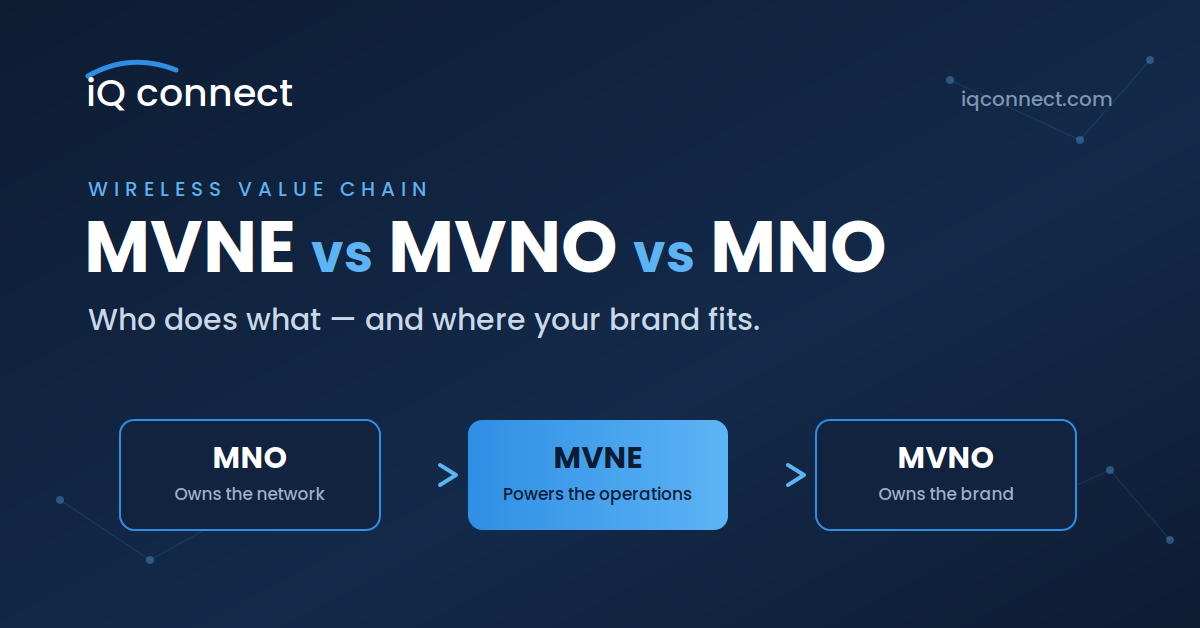
If you're planning to launch a wireless brand, three acronyms will show up in every conversation: MNO, MVNO, and MVNE. Here's the short answer: an MNO (Mobile Network Operator) owns the cell towers and spectrum. An MVNO (Mobile Virtual Network Operator) sells wireless service under its own brand without owning a network. An MVNE (Mobile Virtual Network Enabler) sits in the middle, providing the billing, activation, and operational systems that make the MVNO's business actually run.
Understanding who does what — and where the money and responsibilities flow — is the difference between a launch that takes 90 days and one that stalls for a year. In this guide, we break down each layer of the wireless value chain, compare MVNE vs MVNO vs MNO side by side, and show you exactly which pieces you need to own versus rent when building your brand.
What Is an MNO? (The Network Owner)
A Mobile Network Operator is a carrier that owns licensed radio spectrum and the physical network infrastructure — towers, base stations, core network, and interconnection agreements. In the United States, the three nationwide MNOs are AT&T, T-Mobile, and Verizon.
MNOs make money two ways:
- Retail: selling service directly to consumers under their own brands.
- Wholesale: selling bulk network capacity to MVNOs, who resell it under different brands.
That second revenue stream is why the MVNO model exists at all. Carriers have enormous fixed network costs and unused capacity; wholesale partners help fill it. This is also why the big three actively maintain MVNO programs — brands like Cricket (AT&T), Metro (T-Mobile), and Visible (Verizon) started or operate as sub-brands or virtual operators on these networks.
What the MNO handles: spectrum licenses, radio access network, network maintenance, coverage, and the wholesale rates MVNOs pay per subscriber or per gigabyte.
What the MNO does not handle for you: your billing, your customer support, your dealer network, your subscriber management, your taxes. That's everything downstream — and it's where MVNOs and MVNEs come in.
What Is an MVNO? (The Brand That Sells the Service)
A Mobile Virtual Network Operator is a company that sells mobile service to end customers under its own brand while riding on an MNO's network. The MVNO owns the customer relationship: the brand, the plans, the pricing, the marketing, the retail channels, and the support experience.
Think of familiar names like Mint Mobile, Boost, Ultra Mobile, or H2O Wireless — none of them own towers. They buy capacity wholesale and compete on price, niche targeting, or distribution.
What an MVNO actually has to operate
Running an MVNO is an operations business, not just a marketing play. Day to day, an operator needs:
- Activations and provisioning — turning on SIMs and eSIMs in real time against the carrier's network.
- Billing and charging — prepaid top-ups, postpaid invoicing, or hybrid models, all PCI-compliant.
- Subscriber lifecycle management — enrollment, plan changes, suspensions, win-back.
- Distribution and dealer management — retail stores, online channels, commissions.
- Tax and regulatory compliance — 911 fees, USF contributions, state and local telecom taxes.
- Reporting and analytics — churn, ARPU, sales velocity.
An MVNO can build all of this in-house (expensive, slow, and risky) or plug into a platform that already has it. Which brings us to the layer most people outside telecom have never heard of.
What Is an MVNE? (The Engine Behind the Brand)
A Mobile Virtual Network Enabler provides the technology and operational infrastructure that MVNOs run on: the OSS/BSS stack, billing engine, activation gateways to the carriers, subscriber management, dealer portals, and often payment and compliance tooling.
The MVNE typically doesn't own the customer relationship and doesn't own the network. It's the enabling layer — the reason a wireless brand can launch in weeks instead of building two years of software first.
A strong MVNE platform gives an operator:
- Pre-built carrier integrations so activations route to AT&T, T-Mobile, and Verizon without custom development. (You can see the ecosystem iQ Connect already connects to on our integrated partners page.)
- A convergent billing engine supporting prepaid, postpaid, and hybrid plans from a single system — the core of any serious wireless solution.
- APIs for automation, so marketplaces and high-volume sellers can push activations, top-ups, and plan changes programmatically through an API solution instead of manual portals.
- Built-in tax and regulatory handling — one of the most underestimated launch blockers, covered in depth by dedicated taxation and regulatory solutions.
MVNE vs MVNA: a quick side note
You may also see the term MVNA (Mobile Virtual Network Aggregator). An aggregator buys wholesale capacity from an MNO and resells it to multiple smaller MVNOs, aggregating their volume to negotiate better rates. Many companies operate as both MVNE and MVNA — providing the platform and the wholesale access. If you're a smaller brand that can't meet a carrier's minimum volume commitments, launching through an aggregator/enabler is usually the practical path.
MVNE vs MVNO vs MNO: Side-by-Side Comparison
|
MNO |
MVNE |
MVNO |
|
|---|---|---|---|
|
Owns spectrum & towers |
✅ Yes |
❌ No |
❌ No |
|
Owns the customer & brand |
✅ (its own retail) |
❌ No |
✅ Yes |
|
Provides billing/OSS-BSS |
For itself |
✅ Yes — its core business |
Rents or builds |
|
Sells to end consumers |
✅ Yes |
❌ Rarely |
✅ Yes |
|
Revenue model |
Retail + wholesale capacity |
Platform fees / per-subscriber |
Retail margin over wholesale cost |
|
Examples |
AT&T, T-Mobile, Verizon |
iQ Connect and similar platforms |
Mint, Ultra, H2O, Boost |
|
Typical launch role |
Supplies the network |
Supplies the machinery |
Supplies the brand & go-to-market |
The simplest mental model: the MNO is the highway, the MVNE is the vehicle and dashboard, and the MVNO is the driver with their name on the door.
How the Money Flows in the Wireless Value Chain
Follow a $40 prepaid plan through the chain:
- The subscriber pays $40 to the MVNO's brand (in-store, app, or kiosk).
- The MVNO keeps the retail margin after paying wholesale network costs to the MNO (directly or through an aggregator).
- The MVNE earns platform or per-subscriber fees for running activations, billing, and support systems.
- Taxes and regulatory fees (911, USF, state/local) are calculated, collected, and remitted — usually through the MVNE's compliance tooling.
- Dealers and distributors in the chain earn commissions, tracked and paid through the platform's hierarchy management.
When any link in that chain is manual — spreadsheet commissions, hand-keyed activations, quarterly tax scrambles — margin leaks out. That's why the enabler layer matters as much as the wholesale rate you negotiate.
Which One Are You? Choosing Your Position in the Chain
- You want to own towers and spectrum → you're building an MNO. (Budget: billions. Timeline: decades. Realistically, this isn't the path.)
- You have a brand, an audience, or a retail footprint → you're an MVNO. Your job is marketing, distribution, and customer experience. Rent everything else.
- You have distribution hierarchies or serve other resellers → you may operate as a distributor/aggregator on top of an MVNE platform.
For 95% of new wireless businesses, the winning formula is: be the MVNO, partner with an MVNE, launch on one (or all three) of the major MNOs. Speed to market beats vertical integration at this stage — you can always in-source components later once you have subscriber volume that justifies it.
If you're mapping out that decision right now, our team walks operators through carrier selection, platform scope, and launch timelines every week — get in touch and we'll pressure-test your plan, no commitment required.
Frequently Asked Questions
What is the difference between an MVNE and an MVNO?
An MVNO is the consumer-facing wireless brand that sells plans and owns the customer relationship. An MVNE is the behind-the-scenes technology provider that supplies the billing, activation, and subscriber management systems the MVNO runs on. The MVNO sells; the MVNE enables.
Can an MVNO exist without an MVNE?
Technically yes — some large MVNOs build their own OSS/BSS stack in-house. In practice, building carrier integrations, a compliant billing engine, and tax automation from scratch takes 12–24 months and significant capital. Most new operators launch on an MVNE platform and only consider in-sourcing at scale.
Is an MVNE the same as an MVNA?
No. An MVNE provides technology and operations (billing, activations, portals). An MVNA aggregates wholesale network capacity and resells it to multiple MVNOs. Some companies do both, which is convenient for smaller brands that need platform and network access in one agreement.
Which MNOs support MVNOs in the United States?
All three nationwide carriers — AT&T, T-Mobile, and Verizon — operate wholesale programs for MVNOs, each with different rate structures, device policies, and volume requirements. A platform with pre-built integrations to all three lets you launch on one network and add or switch later without rebuilding your stack.
How long does it take to launch an MVNO with an MVNE?
With an established enabler platform, a straightforward prepaid MVNO can go live in roughly 30–90 days, depending on carrier approval, branding, and distribution setup. Building the same capabilities independently typically takes well over a year.
How does an MVNO make money?
The MVNO buys network capacity at wholesale rates and sells plans at retail prices; the spread is gross margin. Profitability then depends on controlling churn, acquisition cost, and operational overhead — which is why automated billing, activations, and commission management directly affect the bottom line.
Want more breakdowns like this? Browse the latest guides and industry analysis in our news room, or learn how the iQ Connect platform unifies activations, billing, and compliance for MVNOs on all three major U.S. networks.
Tags