
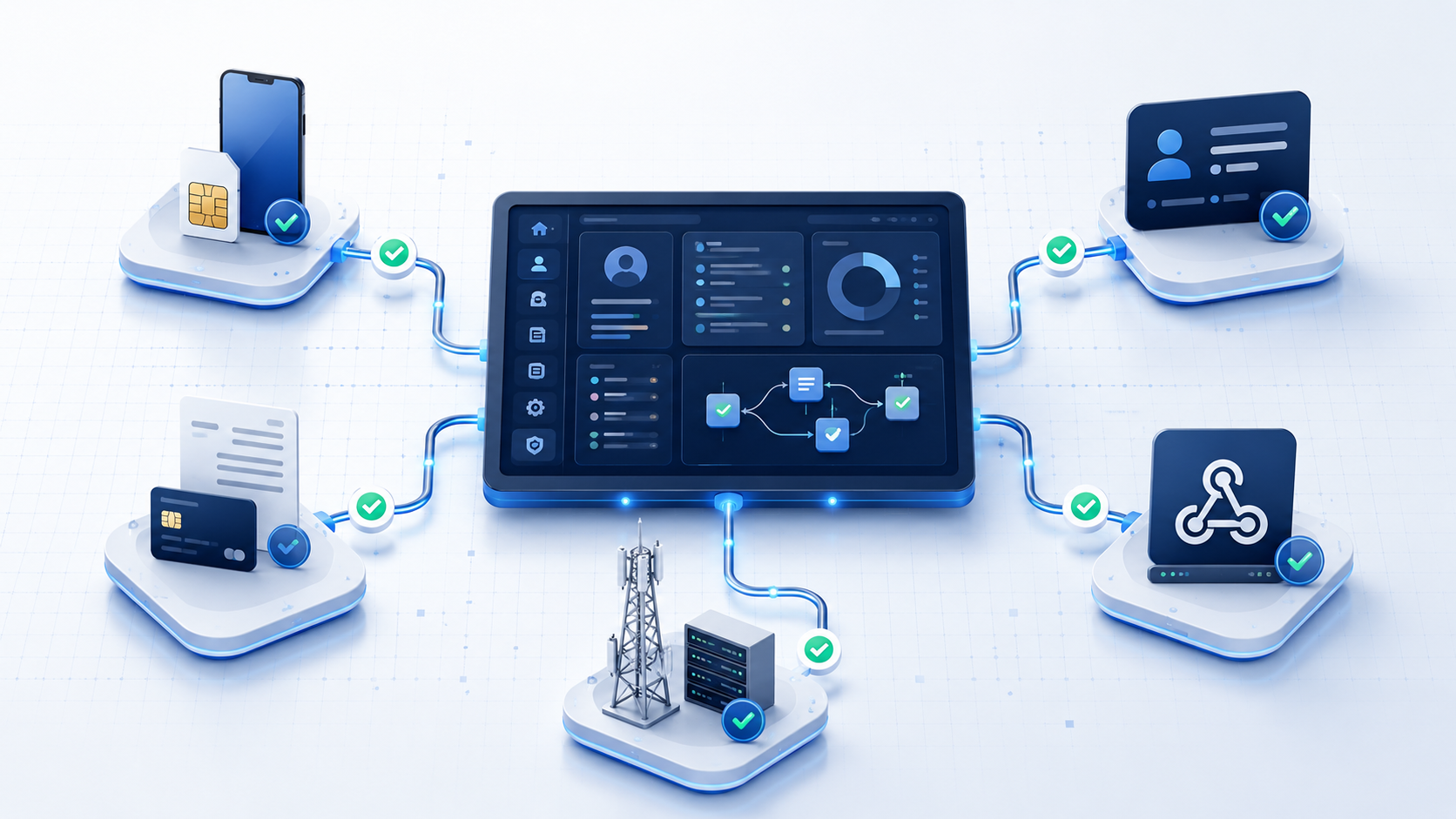
MVNO API Integration Checklist for Telecom Operations
Evaluate MVNO APIs for activations, provisioning, subscriber data, billing, payments, and event-driven workflows before integration.
MVNO API Integration Checklist for Telecom Operations
An MVNO API integration is ready only when the complete subscriber journey works across every connected system. A successful endpoint response does not prove that activation, billing, provisioning, or the customer-facing application reached the correct state.
Telecom workflows cross systems and ownership boundaries. The evaluation must therefore test business outcomes, data consistency, and exception handling before the integration moves to production.
Use this checklist to define scope, resolve architecture decisions, test critical journeys, and document the controls that require confirmation from the vendor.
1. Map the Operational Scope
Start with the subscriber journeys the business intends to run. For each journey, document the initiating system, required data, decision points, final status, and accountable team.
Activation and provisioning
Activation may involve eligibility checks, SIM assignment, plan selection, subscriber creation, payment confirmation, provisioning, and status reconciliation. Define the inputs and expected outputs for every step.
IQ Connect publicly lists API support for activations, SIM swaps, plan changes, and port-ins. Give each in-scope workflow its own sequence diagram and acceptance criteria instead of treating all of them as a generic activation.
Subscriber and financial records
Subscriber information changes throughout the service lifecycle. Define how accounts are created, updated, suspended, and reactivated, and identify which application may change each field.
- Assign an authoritative system for identity, plan, service status, balance, payment state, and activation status.
- Mark fields as read-only, editable, or subject to operational approval.
- Use a correlation identifier that connects workflow, subscriber, billing, payment, and settlement records.
- Define what operator and customer-facing applications display while a change is pending.
For billing and payments, traceability must extend beyond a successful charge. Teams need enough connected evidence to investigate incomplete, disputed, or mismatched transactions.
IQ Connect publicly lists APIs for billing, payments, settlements, financial reporting, and transaction traceability. Confirm the exact objects, payment scenarios, and workflow boundaries required for the implementation.
2. Set Architecture Rules Before Development
Assign systems of record
Shared data needs a single authoritative owner. If several systems can commit the same status independently, conflicting records become difficult to detect and reconcile.
- Map every required entity, identifier, field format, and allowed lifecycle state.
- Define which system may propose a change and which system may commit it.
- Document validation rules and status transitions before coding begins.
Choose requests, webhooks, or both
Use request-response APIs when an application must create, retrieve, or change a resource and receive an immediate result. Use event notifications when another system must react to a later state change without repeatedly polling.
IQ Connect publicly lists webhooks and event triggers associated with activations, payments, renewals, and churn signals. Confirm which events apply to the planned scope, what each payload contains, and how the receiving system reconciles the outcome.
Confirm implementation controls
Public solution pages do not contain every detail needed for architecture approval. Treat the following as due-diligence questions, not as assumed IQ Connect product features.
- Access: Which authentication and authorization methods are supported, and how are credentials rotated?
- Environments and capacity: What non-production access and rate limits apply?
- Change management: How are versions, deprecations, and breaking changes communicated?
- Reliability: Which operations may be retried, and how are duplicate submissions prevented?
- Event security: How are webhook senders verified and replayed or out-of-order events handled?
- Observability and data protection: Which identifiers, errors, logs, masking, retention, and role restrictions apply?
- Support: How are incidents, configuration changes, escalations, and rollbacks managed?
Add the confirmed answers to the architecture decision record and production runbook. Require written confirmation for any control that is essential to the business or security model.
3. Test the Complete Subscriber Journey
Happy-path test
A happy-path test must prove the intended result in every relevant system, not only the initial API response.
- Create or identify a test subscriber with valid data.
- Start the workflow from the real originating application.
- Confirm the request has a traceable correlation identifier.
- Verify the operational, subscriber, billing, payment, and provisioning states.
- Confirm the customer-facing or partner-facing experience displays the correct final state.
Repeat the journey for each workflow in scope, including plan changes, SIM swaps, port-ins, suspension, reactivation, payments, and renewals.
Failure and asynchronous tests
Production readiness depends on predictable exception handling. Every test should define whether the result is failed, pending, partially completed, or safe to retry, as well as who owns the next action.
- Send incomplete or malformed data to verify validation.
- Submit the same business request more than once to test duplicate handling.
- Interrupt a downstream dependency and inspect the recorded workflow state.
- Deliver events late or out of order and confirm the final state remains correct.
- Create a payment or activation exception and verify that operations can find the related records.
For asynchronous operations, define the maximum pending period, how status is checked, which event marks completion, and how disagreements between systems are surfaced and reconciled.
4. Production Readiness Gates
Approve production only when the evidence shows that the integration can be operated safely, not simply demonstrated successfully.
- Every in-scope workflow has an owner, sequence diagram, and measurable acceptance criteria.
- Data ownership, permitted updates, and correlation identifiers are documented.
- Happy-path, failure, duplicate, delayed, and out-of-order scenarios have passed.
- Security, environment, capacity, versioning, retry, event, and support questions have documented answers.
- Monitoring, reconciliation, escalation, rollback, and fallback procedures are ready.
- The final design reflects the vendor's current documentation and the operator's actual architecture.
Where IQ Connect Fits
IQ Connect provides an API integration layer for development teams, digital marketplaces, MVNOs, and ISV or SaaS platforms. Its public capability set covers key subscriber, activation, billing, payment, data, and event workflows. Review the API & Integrations solution for the current published scope.
These capabilities connect to IQ Connect's broader OSS/BSS platform for activation and provisioning, subscriber lifecycle management, billing, partner operations, and analytics. The integrated partners page provides the current public list of partner systems and operational categories.
Frequently Asked Questions
What processes can an MVNO API automate?
It can automate the workflows exposed by the platform and approved in the integration design. IQ Connect publicly lists subscriber, activation, billing, payment, data, webhook, and event capabilities; confirm the exact scope during technical review.
When should an MVNO use webhooks instead of polling?
Use webhooks when another system must react to an event or later state change. Use polling when the current state must be retrieved on demand or no event mechanism is available; many integrations use both.
How should activation and provisioning APIs be tested?
Test the complete journey across the originating application, OSS/BSS workflow, subscriber record, billing or payment record, provisioning status, and customer-facing experience. Include valid, invalid, duplicate, delayed, and failed scenarios.
What should developers confirm before integration?
Confirm the workflows, data objects, ownership rules, access controls, environments, limits, change policies, retry behavior, event handling, observability, and support process. Record vendor-specific answers instead of relying on assumptions from another API.
Final Evaluation
The decision should rest on whether the platform, data ownership, controls, and support model fit the operator's real subscriber journeys. A reliable integration preserves consistent state and gives teams enough evidence to resolve exceptions.
If your team is evaluating an MVNO API integration, request an API and workflow review with IQ Connect. Bring your system map, target journeys, data ownership questions, and acceptance criteria.
EDITORIAL VERIFICATION NOTES - NOT PART OF THE PUBLICATION COPY
Product facts used in this draft were verified against IQ Connect's current public solution pages. Reconfirm the pages immediately before publication and remove or revise any capability that is no longer stated.
Guardrail: Authentication, sandbox access, rate limits, versioning, deprecation, retry behavior, idempotency, webhook verification, and implementation timelines are presented as buyer questions. Do not convert them into IQ Connect product claims without written product confirmation.
Tags