
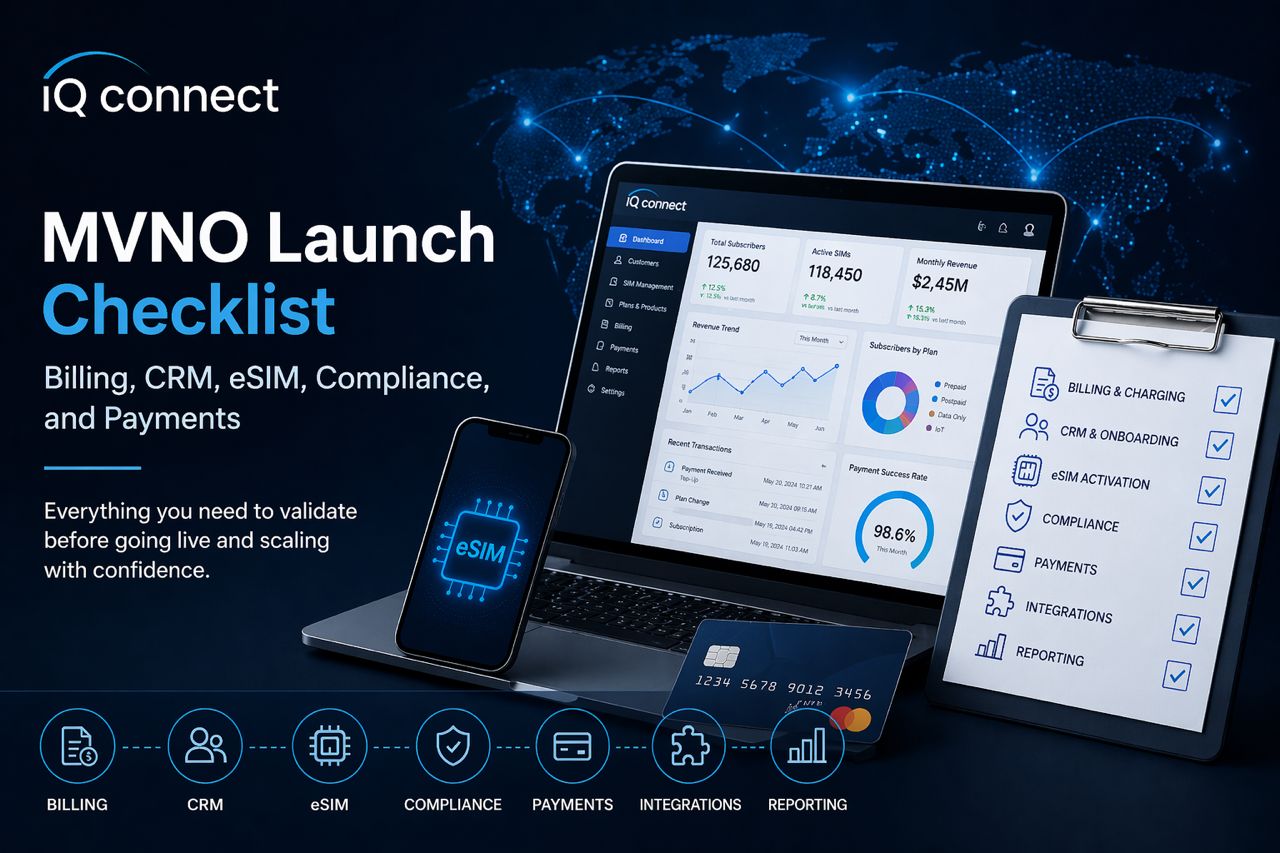
MVNO Launch Checklist: Avoid Billing, CRM & Payment Failures Before Go-Live
Launch your MVNO without costly failures. Validate billing, CRM, eSIM, payments, and compliance before go-live with this checklist.
MVNO Launch Checklist: Billing, CRM, eSIM, Compliance, and Payments
Launching an MVNO is not a marketing milestone. It is an operational stress test. The real question is not whether your brand is ready to go live. It is whether your systems can support activation, billing, compliance, collections, and reporting without creating avoidable friction the moment customers start signing up.
That is where many MVNO launches break down. Commercial plans are approved early, but billing rules, onboarding logic, tax handling, payment flows, and activation processes remain disconnected behind the scenes. The result is predictable: support volume spikes, finance teams start reconciling manually, and the business loses margin before it has even scaled.
A serious MVNO launch checklist needs to evaluate infrastructure, not presentation decks. If CRM, charging, payments, provisioning, tax logic, and reporting do not operate as one connected model, you are not looking at a launch-ready stack. You are looking at operational debt.
For operators assessing launch readiness, iQ Connect positions itself as a unified telecom operating platform that brings together CRM, billing, online charging, taxation, and payment processing in a single environment.
What an MVNO Needs Before Launch
Before an MVNO goes live, five areas need to be fully validated, not discussed, and not partially configured. Validated.
1. Product and plan structure
Your offers need to work operationally, not just commercially. That includes prepaid and postpaid logic, bundles, promos, add-ons, roaming, usage thresholds, renewals, and partner settlement implications. A pricing model that looks clean in a spreadsheet can still fail when it hits real charging and billing rules.
2. Billing and charging
Billing is usually the first place where launch complexity becomes visible. As soon as you add top-ups, discounts, taxes, bundles, roaming, wallet balances, or hybrid plans, weak systems resort to manual workarounds. That is where errors compound.
3. CRM and onboarding
An MVNO cannot scale solely on lead capture. The onboarding flow must move smoothly from customer data collection to plan selection, identity validation, activation, support visibility, and downstream billing records. If sales, support, and operations are each using different systems, the customer experience deteriorates quickly.
4. Payments and reconciliation
Revenue does not come from activations. It comes from successful collections. You need to know how payments are authorized, recorded, retried, refunded, matched, and reconciled. If payment data and subscriber data are split across tools, finance and operations will spend too much time solving the same exceptions twice.
5. Compliance and reporting
Compliance should be built into the launch model, not added later as a reporting exercise. Telecom operators deal with regulated services, tax requirements, customer recordkeeping, and audit expectations that are materially more complex than standard SaaS billing environments.
Billing and Charging Requirements
If billing is fragile, the launch is fragile. This is the system that connects pricing logic, usage events, taxation, collections, credits, invoices, and reporting. When teams underestimate billing requirements, they usually discover the problem after the commercial team starts changing offers faster than operations can support them.
At a minimum, the billing layer should support:
- Plan creation and plan changes
- Real-time charging is required
- Invoice generation
- Discount and promotion logic
- Tax calculation
- Top-ups and balance management
- Reconciliation
- Audit-ready reporting
If your team still needs spreadsheets to bridge rating, invoicing, or revenue validation, the stack is not ready. That is not a small workflow issue. It is a structural launch risk.
A useful benchmark here is the broader architecture expected in telecom billing systems, where usage processing, accounts, rating, invoicing, and payments must work as one connected revenue chain. See this technical overview from RF Wireless World for a high-level breakdown of telecom billing components.
For operators looking at a unified launch architecture rather than stitched-together tools, iQ Connect is built on the same core stack: caRM, billing, online charging, taxation, and payments.
CRM and Customer Onboarding Workflow
Onboarding is where technical gaps become customer-visible. A front-end flow can look polished and still fail operationally if the data does not pass cleanly into activation, billing, and support systems.
Your CRM and onboarding workflow should cover more than lead intake. It should support identity capture, eligibility checks, order validation, activation status, support history, communication triggers, and lifecycle visibility in one operating flow.
This matters even more for digital-first MVNOs. Speed alone is not the win. A fast journey that creates failed activations, duplicate records, or support escalations is expensive growth.
If you want the blog to subtly reinforce your commercial angle, this is a good place to include an internal product mention. One of them is iQConnecs, the system layer that reduces handoff failures across boarding, billing, and payments. That is consistent with its public positioning as an end-to-end SaaS environment for telecom operators.
eSIM Activation and Device Readiness
If your launch depends on digital activation, eSIM readiness should be tested early and aggressively. Too many operators treat eSIM as a nice front-end convenience and only discover the back-end complexity after failed installs or incomplete provisioning start generating support tickets.
Your eSIM checklist should include:
- Device compatibility validation
- eSIM delivery workflow
- QR or digital activation experience
- Provisioning status visibility
- Fallback handling for failed installs
- Customer support paths for incomplete activations
For technical grounding, the GSMA eSIM resources are a credible external reference point on eSIM standards and ecosystem requirements.
If your distribution model includes retail, kiosk, hospitality, or travel environments, the activation design needs even more discipline. Multilingual UX, payment confirmation, identity capture, exception handling, and low-touch support need to be considered before launch. Otherwise, activation friction becomes a direct conversion problem.
Payments, Reconciliation, and Revenue Control
Payment infrastructure is often treated as a checkout issue when it is really a control issue. The launch model needs to define how customers pay, how transactions are logged, how failures are retried, how refunds are processed, and how finance reconciles payment records against billing events.
This is where margin quietly gets lost. Fragmented payment systems create refund delays, mismatched records, manual exception handling, and poor revenue visibility. That does not always appear in launch presentations, but it does in operations.
A stronger model connects payment processing to subscriber records, billing events, and reporting. That reduces operational drag and gives finance teams a cleaner audit trail.
For payment security and control requirements, referencing the PCI Security Standards Council is appropriate when discussing how payment environments should be governed. PCI DSS remains a core benchmark for organizations handling payment card data.
If you want a stronger internal commercial bridge here, you can naturally point back to iQ Connect as a platform designed to unify payments with telecom billing and customer operations. That alignment is consistent with its public product description.
Taxation, Compliance, and Reporting
Compliance is not a cleanup project for after go-live. It needs to be part of the system design from the start. Telecom products are regulated differently from ordinary subscription software, and the reporting burden can become painful very quickly when the operating model is fragmented.
Your launch checklist should confirm that the platform can:
- Apply the correct tax logic
- Store the required transaction records
- Support reporting by business and finance teams
- Provide audit-ready outputs without manual extraction
If compliance depends on custom downstream reporting, the architecture is already creating risk. That risk compounds as plan structures, jurisdictions, and channel models become more complex.
Integrations You Should Validate Before Go-Live
Most launch delays do not occur within a single platform. They happen between platforms. That is why integrations deserve a separate validation step before go-live.
At a minimum, you should test:
- Customer creation
- Product assignment
- Activation and provisioning events
- Payment confirmation
- Billing event synchronization
- Tax application
- Reporting outputs
- Settlement and reconciliation logic
The key question is not whether an integration exists. The real question is whether it reduces operational complexity or shifts it somewhere harder to see.
If your stack depends on brittle custom bridges, every pricing change, partner update, workflow adjustment, and compliance request will take longer than it should.
Final MVNO Go-Live Checklist
Before approving launch, validate the following in a live-state testing environment:
- Plan and pricing configuration completed
- Billing and charging logic tested
- CRM and onboarding flow mapped end-to-end
- eSIM activation scenarios validated
- Payment processing connected and tested
- Tax logic confirmed
- Compliance reporting reviewed
- Partner and integration flows tested
- Finance reconciliation workflow approved
- Support teams trained on exception handling
This final review should be based on actual customer journeys, not internal assumptions. If the team cannot simulate sign-up, payment, activation, billing, support, and reporting as one continuous process, the launch is not operationally ready.
Why the Right Platform Changes Launch Economics
The commercial value of a unified telecom platform is not convenience. It is control. When CRM, billing, charging, payments, tax logic, and reporting live inside one operating layer, operators can move faster without creating unnecessary support overhead or finance complexity.
That is the practical case for evaluating iQ Connect in a launch scenario. Publicly, the platform is positioned as an integrated SaaS solution for MVNOs, telecom operators, and wireless distributors, with core functions across CRM, billing, online charging, taxation, and payment processing.
That kind of architecture matters because disconnected systems make growth more expensive than it needs to be. They increase handoff failures, slow down commercial changes, and raise the cost of support, reconciliation, and compliance over time.
Conclusion
A real MVNO launch checklist should measure operational readiness, not just strategic intent. Billing, onboarding, eSIM activation, payments, compliance, and integrations must all function as one single, connected operating model before go-live.
That is what separates a launch that can scale from one that starts generating preventable friction on day one. If you are reviewing your stack now, this is the point to fix architecture before complexity compounds.
Rebuilding the operating model after subscriber growth starts is always more expensive than tightening it before launch.
FAQs
1. What is the most important system in an MVNO launch?
Billing is usually the most critical dependency because pricing, charging, collections, taxation, and reporting all connect back to it. In practice, though, no single system carries the launch alone. Billing, CRM, onboarding, and payments need to work together for the operation to hold.
2. Should an MVNO use separate tools for CRM, billing, and payments?
It can, but that usually increases launch risk. A fragmented stack tends to create reconciliation issues, slower commercial changes, inconsistent customer records, and more manual operational work. Unified platforms are typically stronger when launch speed and control both matter.
3. When should eSIM workflows be tested in an MVNO project?
Before go-live and with real activation scenarios. Device compatibility, QR delivery, provisioning visibility, failed install handling, and support workflows should all be validated before customer traffic starts. The GSMA eSIM framework is a useful external reference for the ecosystem context.
4. Why does payment infrastructure matter so much in an MVNO launch?
Because activations do not equal revenue. Revenue depends on successful payment capture, retries, refunds, reconciliation, and reporting. A weak payment model creates silent margin leakage and unnecessary operational overhead.
5. What should operators look for in an MVNO launch platform?
Look for operational depth, not just feature breadth. The platform should support CRM, billing, charging, payments, tax handling, reporting, and integration workflows, reducing annual effort and making nature changes easier to manage. Publicly, iQ Connect is positioned around exactly that kind of unified telecom operating layer
Tags