
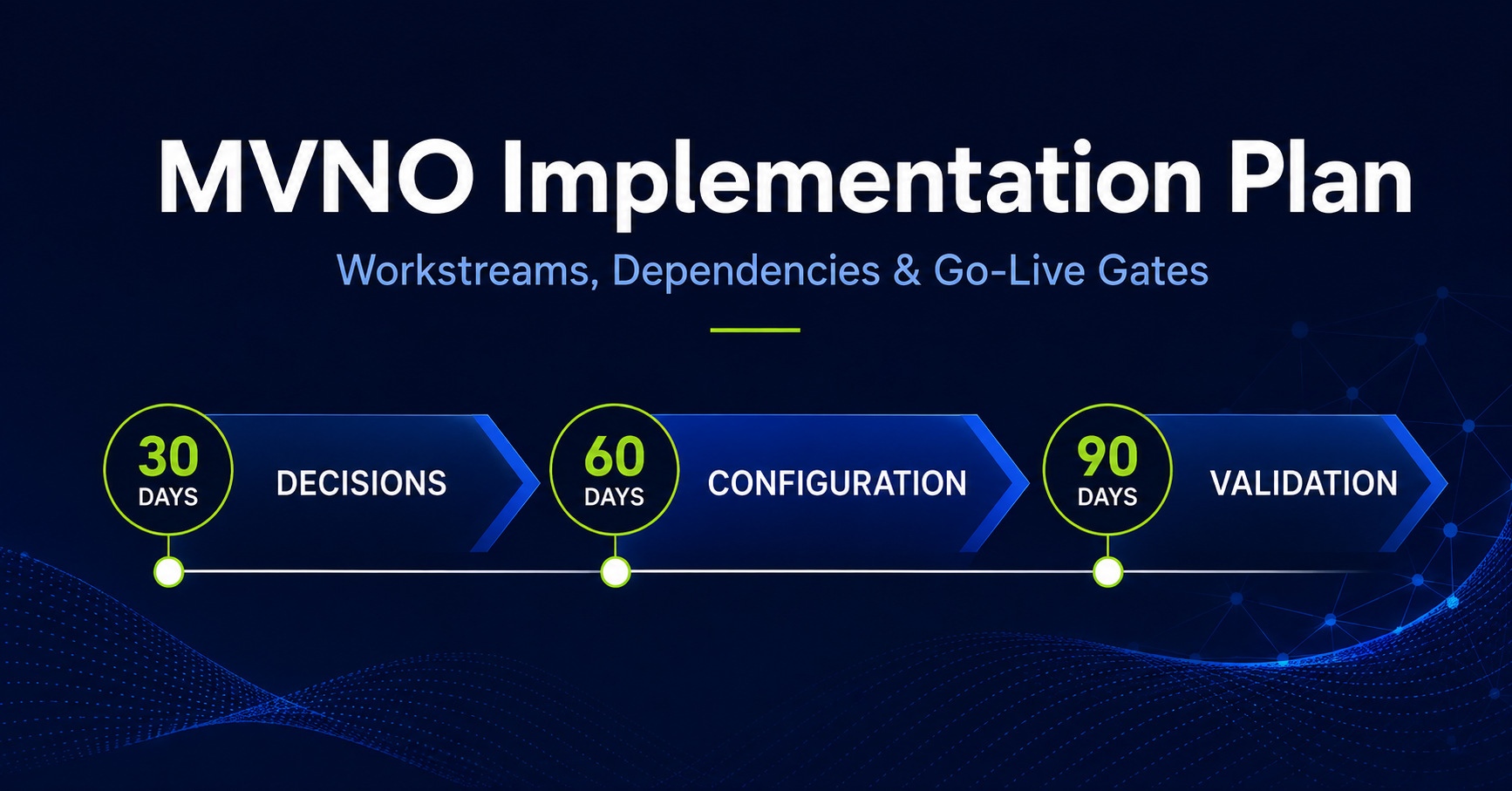
MVNO Implementation Plan: Workstreams, Dependencies & Go-Live Gates
Build an MVNO implementation plan around carrier dependencies, platform configuration, integrations, testing, pilot, and cutove
MVNO Implementation Plan: A 30-60-90 Day Framework for Carrier, Platform, and Channel Workstreams
An MVNO implementation plan should show more than a target launch date. It should connect commercial decisions, carrier dependencies, platform configuration, integrations, operational readiness, testing, and cutover activities into a schedule that teams can manage.
The 30-60-90 day framework below is a planning model, not a universal promise. Some workstreams can run in parallel, while others depend on carrier approvals, finalized requirements, technical access, third-party integrations, or decisions made by the operator.
The purpose is to make those dependencies visible before they become launch delays.
What an MVNO Implementation Plan Must Control
A wireless launch involves several teams and systems. If each team works from a separate schedule, important dependencies remain hidden until late in the project.
A practical implementation plan should define five elements for every workstream:
- The accountable owner
- The required inputs
- The expected output
- The dependency that could delay progress
- The evidence required to advance to the next phase
| Workstream | Primary owner | Main dependency | Exit evidence |
|---|---|---|---|
| Carrier and commercial scope | Partnership or program lead | Carrier terms, network inputs, approved operating model | Documented scope and responsibilities |
| Product and plan structure | Product, finance, and operations | Pricing, eligibility, promotions, billing rules | Approved plan catalog |
| Platform and integrations | Technical lead | Architecture, data mapping, access, integration scope | Configured workflows and test environment |
| Channel and support readiness | Operations or channel lead | Customer, dealer, and support processes | Training and operating procedures |
| Validation and cutover | Program sponsor, QA, and operations | Stable configuration and resolved defects | Pilot approval and cutover decision |
This structure prevents the project from becoming a list of disconnected tasks. A platform may be configured, for example, while the commercial team is still changing plan rules. A customer-facing application may be ready while provisioning or payment workflows remain untested.
The schedule must show those relationships.
Days 0–30: Decisions That Unlock the Build
The first 30 days should establish the decisions that downstream teams need before configuration and integration work can move forward.
Confirm the carrier and operating model
The operator should document which carrier relationships, network services, distribution channels, and operating responsibilities are included in the initial scope.
This work may involve external approvals and commercial negotiations. It should not be treated as a software task. The implementation team needs to know which technical and operational inputs are available, which remain pending, and who owns each decision.
At this stage, document:
- The initial carrier and service scope
- The intended customer segments
- The sales and distribution channels
- The operating responsibilities of the MVNO and its partners
- The dependencies that require carrier or third-party approval
- The requirements that are deferred from the initial launch
A clear scope protects the project from uncontrolled expansion. Adding a new carrier, channel, plan type, or customer journey late in the build can affect integrations, testing, training, reporting, and support procedures.
Finalize the product and plan catalog
The technical team cannot configure reliable workflows around incomplete commercial requirements.
The operator should define the products, plans, eligibility rules, promotions, add-ons, renewal logic, and account states that belong in the initial launch. The catalog should also identify which rules affect billing, payments, provisioning, partner attribution, or customer communications.
The output should be a controlled plan catalog that answers:
- Which plans are available at launch?
- Which customers qualify for each plan?
- Which changes can subscribers request?
- What happens when a plan is suspended, renewed, changed, or canceled?
- Which promotions have an end date or eligibility condition?
- Which partner or dealer receives attribution for the transaction?
This does not require every future product decision to be complete. It does require the launch scope to be stable enough for configuration and testing.
Establish architecture and data ownership
Before development begins, the project should identify where key records live and which system owns each status.
At a minimum, document ownership for:
- Subscriber identity
- Plan assignment
- Service status
- Activation status
- Payment status
- Account balance
- Dealer or partner attribution
- Transaction history
- Support and escalation records
The goal is to prevent multiple systems from independently changing the same record without reconciliation. Every major workflow should have a defined initiating system, destination, status transition, and accountable owner.
The MVNO launch checklist can support the readiness review for the systems that must work together. This implementation plan serves a different purpose: showing when those decisions and dependencies must be resolved.
Days 31–60: Configure the Platform and Connect the Workstreams
Once the launch scope is defined, the project can move into configuration, integration, and operational design.
Configure the operational workflows
The platform configuration should reflect the approved plan catalog and the subscriber journeys defined during the first phase.
Those journeys may include:
- New subscriber activation
- SIM or eSIM assignment
- Plan selection and changes
- Port-in requests
- Payments and account updates
- Suspensions and reactivations
- Refills or renewals
- Dealer or partner transactions
Each workflow should have a documented starting event, required data, expected status changes, exception path, and final outcome.
IQ Connect publicly describes an OSS/BSS platform that supports activations and provisioning, prepaid, postpaid, and hybrid billing, subscriber lifecycle management, partner portals, commission structures, and operational analytics.
The implementation team should still confirm the precise scope required for the operator’s architecture. Public capability descriptions do not replace project-level configuration decisions.
Connect external systems and integrations
Integration work should focus on business outcomes, not only endpoint availability.
For every connection, document:
- The systems involved
- The data exchanged
- The event that starts the workflow
- The expected response
- The system of record
- The behavior when the request is delayed or rejected
- The owner responsible for resolving exceptions
IQ Connect’s public API and integrations solution lists workflows for activations, SIM swaps, plan changes, port-ins, billing, payments, settlements, subscriber management, data synchronization, webhooks, and event triggers.
The MVNO API integration checklist provides a more detailed framework for mapping those workflows and defining acceptance criteria. The new implementation article should link to it instead of reproducing its testing methodology.
Prepare customer, dealer, and support operations
Implementation is not complete when the platform works in a test environment. The teams using the workflows must know what to do when an activation is pending, a payment fails, a subscriber record does not reconcile, or a dealer needs an escalation.
During this phase, prepare:
- Internal operating procedures
- Dealer or partner instructions
- Support escalation paths
- Exception-handling responsibilities
- Training materials
- Reporting requirements
- Launch-day communication procedures
Training can begin before every integration is complete, but final training should use the approved configuration and documented exception paths.
Days 61–90: Validate, Pilot, and Prepare Cutover
The final phase should demonstrate that the operating model can support real transactions and that the launch team can respond when a workflow does not follow the expected path.
Run structured user acceptance testing
UAT should be organized around business journeys rather than isolated demonstrations.
A test matrix may include:
- New activation
- Failed activation
- Duplicate submission
- Plan change
- SIM or eSIM assignment
- Port-in
- Successful payment
- Declined payment
- Renewal or refill
- Suspension and reactivation
- Dealer attribution
- Reporting and reconciliation
Each test should identify the expected result, the system that owns the result, the evidence required, and the person responsible for approval.
The objective is not to prove that every screen works. It is to confirm that the connected workflow produces the correct operational, financial, subscriber, and customer-facing state.
Define the pilot scope
A pilot should be limited enough to control risk and broad enough to expose real operational problems.
The pilot plan should define:
- Who is included
- Which plans and channels are included
- Which transactions are allowed
- Which metrics are monitored
- Who reviews exceptions
- How issues are prioritized
- What conditions require a pause or rollback
A pilot does not remove the need for full production readiness. It gives the implementation team evidence about how the configured workflows behave under controlled operating conditions.
Prepare cutover and hypercare
Cutover planning should specify the sequence of launch activities, owners, decision points, communications, and fallback procedures.
The plan should address:
- Final configuration approval
- Data and account readiness
- Access and permissions
- Support coverage
- Monitoring responsibilities
- Escalation contacts
- Transaction reconciliation
- Defect triage
- Rollback or pause criteria
- Post-launch review schedule
Hypercare should have a defined duration and ownership model. Without that structure, unresolved launch issues can move between technical, operations, finance, and support teams without a clear resolution path.
Which MVNO Implementation Tasks Can Run in Parallel?
A realistic schedule is not a single line of sequential tasks.
Some activities can progress at the same time:
- Commercial planning and carrier due diligence
- Support-process design and platform configuration
- Dealer onboarding preparation and reporting design
- Customer experience planning and integration mapping
- Training development and test-case creation
- Data mapping and internal documentation
Other activities require a preceding decision or stable output:
- Final platform configuration requires approved product rules.
- End-to-end UAT requires stable integrations and test data.
- Pilot approval requires resolved critical defects.
- Cutover approval requires operational ownership and support readiness.
The implementation plan should show both types of work. Compressing the schedule by ignoring a dependency does not remove the dependency. It moves the risk closer to launch.
What Usually Moves the Critical Path?
The critical path is determined by the slowest dependency that blocks a required downstream activity.
Common schedule risks include:
Carrier approvals and technical inputs
A project may have a configured platform but remain unable to complete testing because required carrier information, access, or approval is pending.
Unstable commercial requirements
Late changes to plans, promotions, eligibility rules, or billing logic can require configuration changes and additional testing.
Unclear data ownership
When teams disagree about which system owns subscriber, payment, or service status, integration defects are more difficult to diagnose.
Third-party integration delays
External applications may have separate development schedules, access requirements, testing processes, or release controls.
Unassigned exception ownership
A workflow may function under normal conditions but fail operationally when no team owns pending, rejected, duplicate, or partially completed transactions.
Incomplete training
If the support and operations teams are not prepared to handle exceptions, the launch may create avoidable escalation volume even when the core platform is functioning.
Five Implementation Gates Before Cutover
The project should use evidence-based gates rather than calendar dates alone.
Gate 1: Scope approval
The initial carrier, product, channel, and operational scope is documented. Deferred requirements are recorded separately.
Gate 2: Architecture approval
Systems of record, data ownership, integration boundaries, and workflow responsibilities are defined.
Gate 3: Configuration and integration readiness
The approved workflows are configured, connected, and available in a controlled test environment.
Gate 4: UAT and pilot approval
Critical journeys, failure scenarios, reconciliation steps, and pilot requirements have passed their acceptance criteria.
Gate 5: Cutover approval
Operations, support, training, monitoring, escalation, communications, and rollback procedures are ready.
If one gate remains incomplete, the project sponsor should decide whether to resolve the issue, reduce the launch scope, or move the date. The decision should be documented rather than hidden inside the schedule.
Where IQ Connect Fits Into the Implementation Model
IQ Connect can serve as the operational platform layer for MVNOs and telecom operators that need connected workflows across subscriber management, activations, provisioning, billing, partner operations, and analytics.
Its public platform information includes:
- Activations and provisioning through configurable workflows
- Prepaid, postpaid, and hybrid billing models
- Subscriber lifecycle management
- White-label partner portals
- Partner hierarchies and commission management
- Operational dashboards and analytics
- API workflows for activations, plan changes, SIM swaps, port-ins, billing, payments, and subscriber data
The exact implementation scope depends on the operator’s carrier relationships, product model, integrations, data requirements, and internal operating responsibilities.
For that reason, IQ Connect should be evaluated as part of the full implementation design, not as a substitute for carrier approvals, commercial decisions, testing ownership, or operational preparation.
Frequently Asked Questions
What is an MVNO implementation plan?
An MVNO implementation plan is a coordinated schedule that defines the decisions, workstreams, dependencies, owners, deliverables, testing activities, and approval gates required to prepare a wireless operation for launch.
Is a 90-day MVNO implementation realistic?
It can be used as a planning framework, but no universal timeline applies to every MVNO. The schedule depends on carrier approvals, scope, integrations, data requirements, configuration, testing, staffing, and operational readiness.
Which MVNO implementation tasks can run in parallel?
Commercial planning, carrier due diligence, support preparation, data mapping, documentation, training development, and some configuration work can overlap. End-to-end testing and cutover approval require stable upstream inputs.
What should an MVNO UAT plan include?
An MVNO UAT plan should include business journeys, expected results, test data, owners, acceptance criteria, failure scenarios, reconciliation evidence, defect priorities, and approval requirements.
Does an OSS/BSS platform replace carrier approval?
No. An OSS/BSS platform can support operational workflows such as subscriber management, billing, provisioning, and activations, but carrier agreements, approvals, technical inputs, and commercial responsibilities remain separate project dependencies.
Conclusion
An MVNO implementation plan is useful when it shows how decisions, systems, teams, and approvals depend on one another.
The 30-60-90 framework provides a practical structure:
- Days 0–30 establish scope, commercial inputs, product rules, and architecture.
- Days 31–60 configure workflows, connect integrations, and prepare operations.
- Days 61–90 validate the journeys, run a controlled pilot, and prepare cutover.
The timeline should remain flexible, but the gates should be specific. When each phase has an owner, an output, and evidence for advancement, the launch schedule becomes easier to manage and the remaining risks become visible before they affect subscribers.
If you are planning an MVNO implementation, schedule a strategy session with IQ Connect to review the operating workflows, platform requirements, integrations, and dependencies behind your launch plan
Tags